Texas Holdem Poker & Blackjack
- 4.5
- Rating
- 1.00M
- Installs
- Free
- Price

 Analysis by App-foxy
I approached Texas Holdem Poker & Blackjack as a casual card-game player rather than a serious poker regular, and that turned out to be the right mindset. This is a free mobile game from Murka Games Limited built around Texas Hold’em poker, with a large level-based mission structure and social play with friends. It is not trying to be a quiet, realistic poker table where every hand is treated like a tournament decision. Instead, it mixes familiar poker rules with progression, chips, and a more game-like rhythm.
That distinction matters before you install it. If you want to practise disciplined bankroll management with real-money consequences, this is not the right destination. If you want short sessions, a colourful way to play poker on a phone, and a reason to return beyond a single table, it makes more sense. I found the strongest part of the experience in that middle ground: the poker is recognizable, but the surrounding structure gives casual players something to work toward.
What the game feels like before you play seriously
The main appeal is easy to understand. You sit down for Texas Hold’em poker, make decisions with your private cards and the shared cards on the table, and try to finish hands successfully. Around that core, the game presents hundreds of Scatter Poker Missions, so each session can feel like part of a larger route rather than an isolated deal. The store summary also highlights playing with friends and receiving a large chip balance, which tells you immediately that this is designed as a social, progression-focused game rather than a stripped-down rules trainer.
You May Also Like

 Blood Strike: 2.5 Anniversary
Blood Strike’s Loadouts Turn Every Drop Into a Tactical Gamble
A close look at Blood Strike’s custom loadouts: how fast access to signature weapons reshapes its battle royale rhythm, rewards preparation, and narrows the gap between fights.

 Pandora - Music & Podcasts
Pandora’s Music Is Easy to Start, but Harder to Recover
Pandora’s strength is its low-effort path from a seed to a station. Its weak spot is how much confidence it asks you to place in connection, setup, and quiet recovery.

 8 Ball Pool
 Is Built on Rivalries, Rematches, and Routine
A close look at the rivalries, rematches, shared routines, and unanswered safety questions that turn a quick pool match into a persistent mobile community.

 Samsung Music
’s Quiet Strength Is Playing What You Already Own
Its reach comes less from spectacle than from dependable access to a personal library. That simplicity is both the app’s strongest retention engine and its ceiling.

 AccuWeather: Weather Radar
AccuWeather Review: A Quick, Clear Forecast for Everyday Decisions
For everyday plans, the best forecast is the one you can understand quickly. AccuWeather makes rain timing, radar, and local conditions easy to act on, with a few trade-offs.

 Hill Climb Racing
Why Hill Climb Racing Still Turns Crashes Into One More Run
A tiny car, a bumpy hill and one more upgrade: Hill Climb Racing keeps resurfacing because its simple chaos makes every near-miss feel personal.
More From Our News Desk



In my experience, the mission approach changes how I judge a hand. In a conventional poker app, I might fold a weak starting hand and feel that I had simply made the correct mathematical choice. Here, the wider goal can make the session feel more purposeful. You are not only waiting for premium cards; you are trying to move through the game’s challenges and keep the session entertaining. That is useful for newcomers who find ordinary poker tables too repetitive.
The game is listed as a card title and carries a Mature 17+ content rating. That does not make it a real-money gambling product, but it does mean I would not treat it as a children’s card game. It is better suited to adults who understand that virtual chips and in-app purchases can encourage longer sessions or extra spending. The game itself is free to start, while optional purchases are listed from $0.99 to $299.99 per item. That range is worth noticing before you become invested in the progression.
Its public reception suggests that plenty of players find the format enjoyable: the game has an average rating of 4.5 from around 79 thousand ratings, with about 15 thousand written reviews and over a million installs. I would not use those figures as a guarantee that you will like it, because poker preferences are personal. Still, they indicate that this is an established mobile game rather than an obscure experiment with no active audience.
Who will get the most from it
I would recommend it to someone who already knows the basic hand rankings but wants a more relaxed way to play. It also suits a friend group that enjoys comparing progress, taking turns at the same game, or using poker as a quick social activity rather than a serious competition. The mission structure gives a new player a simple reason to continue after learning the rules.
It is less suitable for a player who wants a pure poker simulator with minimal distractions. The progression layer, virtual-chip economy, and social emphasis are part of the identity here. A player who prefers long, thoughtful tournament sessions may find the mobile format too game-like. Likewise, someone who dislikes in-app purchases should decide in advance to treat the free experience as a fixed boundary, not as an invitation to buy chips whenever progress slows.
Getting started without overthinking the first screen
After installing, my advice is to resist the urge to chase every visible reward immediately. First, identify the table controls and learn which actions are available during a hand: folding, checking, calling, or raising when the situation allows. The most useful early goal is not to win quickly. It is to understand the timing of each decision and notice how the shared cards change the strength of your hand.
The game runs on Android from version 5.1 onward, so it is available to a broad range of devices. The current version is 2.31.0. That makes it approachable for people who are not using a recent flagship phone, although actual smoothness will still depend on the device and its background workload. I would install it on the phone you normally use for casual play, then give yourself a few quiet minutes rather than opening it while distracted.
A practical first-session routine is simple. Look at your private cards, identify whether they form a promising pair or connected combination, and then compare them with the community cards as they appear. Do not raise merely because the game makes an action button prominent. On mobile, the interface can make tapping feel like progress, but folding a poor hand is often the first genuinely good decision a beginner makes.
It is also worth deciding how you want to handle chips before you begin. Think of them as the fuel for the game’s virtual progression, not as money that can be recovered or converted. If you keep that mental separation from the start, the purchase prompts are easier to evaluate. You can enjoy the free entry point without confusing a temporary digital balance with something of real financial value.
Your first meaningful success at the table
For a beginner, I would define success as completing a hand with a clear reason behind every action. Suppose you receive a modest starting hand and the first shared cards do not improve it. Instead of calling automatically, ask whether you are drawing toward a realistic improvement and whether the current cost makes sense for the mission you are pursuing. That small pause is more valuable than a lucky early win because it gives you a repeatable habit.
When the board does help you, avoid assuming that any pair is unbeatable. Look for possible straights, flushes, or stronger pairs among the shared cards. This is where the game can teach useful poker awareness, even though its mission structure keeps the mood lighter than a conventional poker room. I found that the best early victories came from combining patience with attention, not from trying to force every hand into a dramatic finish.
The mission system can also change your priorities. If a task encourages a particular kind of outcome, it may be tempting to play hands you would normally discard. I would treat that as an optional challenge rather than a command to abandon sensible play. A mission is valuable when it gives you a fresh objective; it becomes frustrating when you let it pressure you into repeated poor decisions.
Playing with friends adds another layer. The social side is most enjoyable when everyone agrees that the session is for entertainment and progress, not for proving who is the best poker player. A short group session can work well during a break or while travelling, especially because each person can focus on their own decisions instead of needing a formal tournament schedule. The trade-off is that social play may feel less satisfying if your friends prefer serious strategy and the game’s broader rewards feel more important than the table itself.
Confusions that can make the early game feel harder
The first common confusion is the difference between poker skill and mission progress. Winning a hand does not necessarily mean you have played perfectly, and failing a mission does not necessarily mean you misunderstood poker. The game combines two systems: decisions at the table and goals outside the hand. I found it easier once I judged them separately. First ask whether the poker decision was sound; then ask whether the mission objective was met.
The second confusion concerns virtual chips. A large chip reward can make the game feel generous at first, but chips are still part of a controlled in-game economy. They are not a substitute for cash, and they should not influence your spending decisions. If you run low, take that as a signal to slow down and review how you are playing rather than automatically buying more. The listed purchase range makes this especially important for anyone who tends to spend impulsively in mobile games.
Another issue is the temptation to treat every hand as a test of courage. Poker rewards selective aggression, not constant action. Beginners often remember the hands where a risky call worked and forget the many similar calls that would have failed. In this game, the mission format may make action feel rewarding, so I recommend keeping a simple personal rule: if you cannot explain what you are hoping to improve or beat, folding is usually more informative than guessing.
There is also a difference between learning hand rankings and learning table judgement. Knowing that a flush beats a straight is only the beginning. You still need to consider what the other cards suggest and whether the board gives opponents a stronger possible combination. The mobile format makes the rules accessible, but it cannot remove uncertainty from poker. That uncertainty is part of the fun, provided you do not mistake it for a promise of predictable rewards.
Three habits that improve the experience
My first practical tip is to use the missions as a pacing tool instead of a pressure tool. Choose a small objective for a session, then stop when you have had enough. This prevents the familiar mobile-game cycle in which one unfinished task turns a short break into a much longer session. It also lets you enjoy the variety of the mission structure without allowing it to dictate every hand.
Second, separate learning sessions from social sessions. When playing alone, concentrate on why you are folding, calling, or raising. When playing with friends, accept that conversation and quick decisions may matter more than perfect analysis. Mixing both purposes at once can be frustrating: you may resent interruptions during a thoughtful hand, or bore friends by treating a casual round like a study exercise.
Third, pay attention to the board before looking at the reward. This sounds obvious, but reward-focused interfaces can pull attention toward the next objective. I found that reading the community cards slowly helped me avoid chasing weak draws. It also made wins feel more earned because I could identify the moment the hand improved and understand why the final result made sense.
A fourth habit is to keep purchases out of your decision-making vocabulary. If you are enjoying the free game, continue at that pace. If progress becomes enjoyable only after spending, reassess whether the game is still serving its purpose. The free price makes experimentation easy, but the optional item range means the safest approach is to establish your limit before the first purchase prompt appears.
How it compares with ordinary poker alternatives
Compared with a basic offline poker app, this game offers more of a continuing journey. The mission structure and friend-focused design create reasons to return, while a simple rules app may be better for learning hand rankings without distractions. If your priority is understanding the mechanics from scratch, a quieter alternative can be more efficient. If your priority is having a reason to play several short sessions, this title has the stronger personality.
Compared with competitive poker platforms, it feels more approachable and less intimidating. You are not required to enter the experience as a highly trained player, and the game-like progression can make early mistakes less discouraging. The cost of that accessibility is that it may not satisfy someone looking for a detailed simulation of serious poker strategy. Players who want rigorous tournament structure, careful bankroll tracking, or a purely competitive environment should look elsewhere.
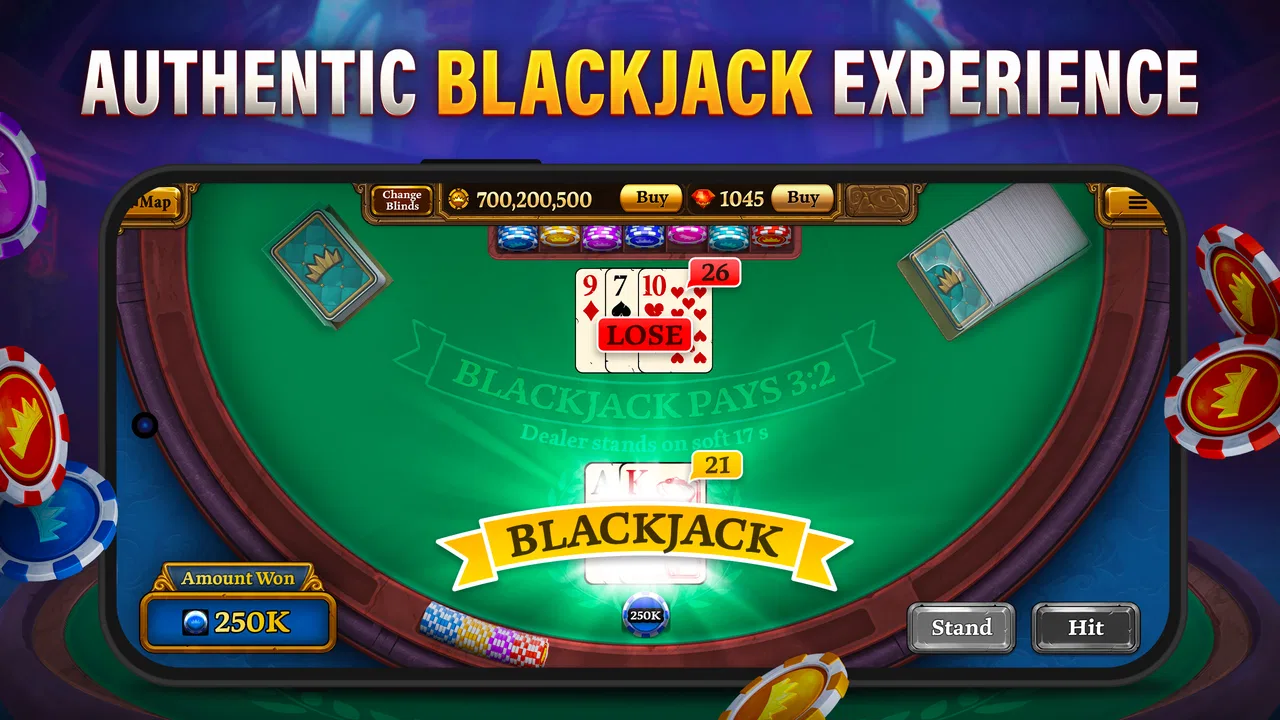
The blackjack reference in the full title may also shape expectations, so I would clarify my own experience this way: the central identity presented here is Texas Hold’em poker, not a broad casino catalogue that treats every table game equally. Install it because you want the poker experience and its mission-driven format. If your main reason is to find a deep blackjack game, this may not be the most direct choice.
What I would do after the first session
Once you understand the controls and have completed a few hands, I would not immediately focus on collecting every possible reward. Instead, review which decisions felt unclear. Were you unsure when to fold? Did you call because of the board or because you did not want to miss the next card? Did a mission encourage you to play outside your comfort zone? Those questions turn the game into a more useful learning experience without removing its casual character.
If you enjoy the first session, playing with friends is the natural next step. The social element gives the game a different rhythm and can make familiar hands feel fresh. Set expectations about whether the group cares more about missions, winning individual hands, or simply spending time together. That small agreement prevents the common problem where one player wants relaxed entertainment and another wants a serious contest.
I would also test the game over several short sessions before deciding whether the progression suits you. One lucky run can make any poker game seem brilliant, while one unlucky run can make it seem unfair. A fairer judgement comes from noticing whether you enjoy the decisions even when the result is disappointing. If the answer is yes, the mission structure is probably adding value. If the answer is no, a simpler poker app may be a better fit.
My final recommendation is cautiously positive. Texas Holdem Poker & Blackjack is a welcoming choice for adults who want free, casual Texas Hold’em with missions, virtual chips, and a social angle. I like that it gives beginners a concrete path from learning the table to having a reason to continue. I also think its limits are clear: it is not a substitute for real-money poker, not the best pure rules tutor, and not ideal for players who dislike progression pressure or optional purchases.
For a first-time user, the winning approach is to play slowly, treat chips as entertainment resources, and measure success by the quality of your decisions rather than by one lucky hand. With that attitude, Murka Games Limited’s card game becomes an easy title to pick up during a spare moment and a reasonably engaging way to share poker with friends. Just keep your boundaries firm, and let the missions support the game instead of taking control of it.
FAQs for Texas Holdem Poker & Blackjack
01What is Texas Holdem Poker & Blackjack?
Texas Holdem Poker & Blackjack is a mobile casino-style game that combines two popular card games in one application. You can play Texas Hold’em poker against virtual opponents and enjoy blackjack hands using standard casino rules. The app is designed primarily for entertainment, practice, and casual play rather than as a substitute for a real casino experience.
02Can I play Texas Holdem Poker & Blackjack offline?
Availability of offline play may depend on the specific version of the app and the feature being used. Some single-player modes can often be accessed without a constant internet connection, while online tables, leaderboards, advertisements, updates, or account-related functions may require internet access. It is best to launch the app once while connected before traveling or playing offline.
03Does the app involve real money or in-app purchases?
Texas Holdem Poker & Blackjack generally uses virtual chips or credits for gameplay, but the exact monetization system can vary by platform and region. Check the store listing and the in-app purchase section before downloading. Virtual currency may be available through gameplay, advertisements, or optional purchases, and it should not be confused with withdrawable real-world winnings.
04Is Texas Holdem Poker & Blackjack suitable for beginners?
Yes, the app can be suitable for beginners because both games are familiar and usually allow players to learn through repeated hands. New users should understand the basics of poker hand rankings, betting rounds, blackjack decisions, and the dealer’s rules before committing virtual chips. Starting with low-stakes or practice modes is a sensible way to learn.
05What devices and permissions does the app require?
The application is intended for compatible Android and iOS devices, although the exact operating-system requirements may change with updates. Before installation, review the official store page for supported versions, storage requirements, and recent compatibility information. The app may request internet access and notifications, while optional permissions can vary depending on advertising, analytics, login, or social features.
Pros
- Smooth gameplay with intuitive controls for quick poker and blackjack rounds.
- Offers both Texas Hold’em and blackjack in one convenient app.
- Helpful practice options let beginners learn without immediate pressure.
- Short sessions make it easy to play during brief free moments.
- Clear card layouts make hands and table actions easy to follow.
Cons
- Online play may depend heavily on the quality of your internet connection.
- Some features or chips may be limited unless you make in-app purchases.
- Random outcomes can make progress feel inconsistent during longer sessions.
- The interface may feel repetitive for players seeking more game variety.
- Frequent notifications or promotional offers can become distracting.

Texas Holdem Poker & Blackjack
Gallery